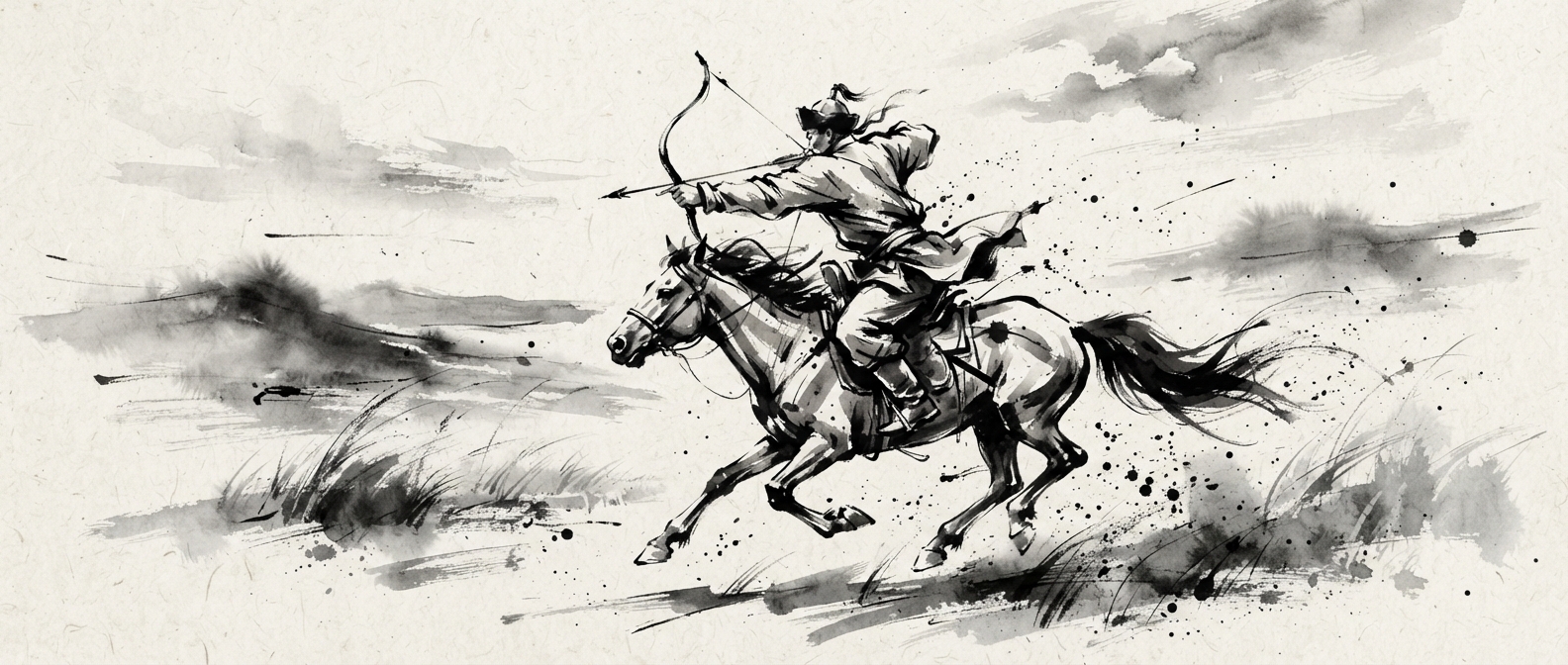
Scythians, Parthians and Huns shot from horseback without stirrups. The stirrup came later, and its story is more tangled than textbooks suggest.
Byzantium and the Avars
Penn, Russell and Wilson (2021) conclude that the Roman–Byzantine army adopted the stirrup only at the end of the 6th century. Hundreds of stirrups are known from Avar graves, against no more than seven Roman–Byzantine examples. The idea that the Avars passed the stirrup to Byzantium rests, they say, on limited evidence; the Strategikon’s mention of “two iron stirrups” can be read differently. They see several sources of influence and some experimentation. A 7th-century stirrup from Aphrodisias is the first datable find in Asia Minor.
Riding without stirrups
No stirrup is known from a Hun site. According to a 2018 summary, scholars date the earliest stirrups very differently: early 1st millennium among the Xiongnu (Tkachenko), 5th century (Littauer), early 4th century among the Xianbei (May). Loades (2016) experimented with a Parthian four-horned saddle: bracing against the front horns, the rider could rise almost as high as standing in stirrups. Experiments by Connolly and Hyland also showed that powerful mounted combat did not require stirrups.
The great stirrup controversy
Lynn White’s 1962 thesis linking the stirrup to the couched lance and feudalism has been widely rejected (Sawyer and Hilton, Bachrach, Contamine, Bennett, Strickland).