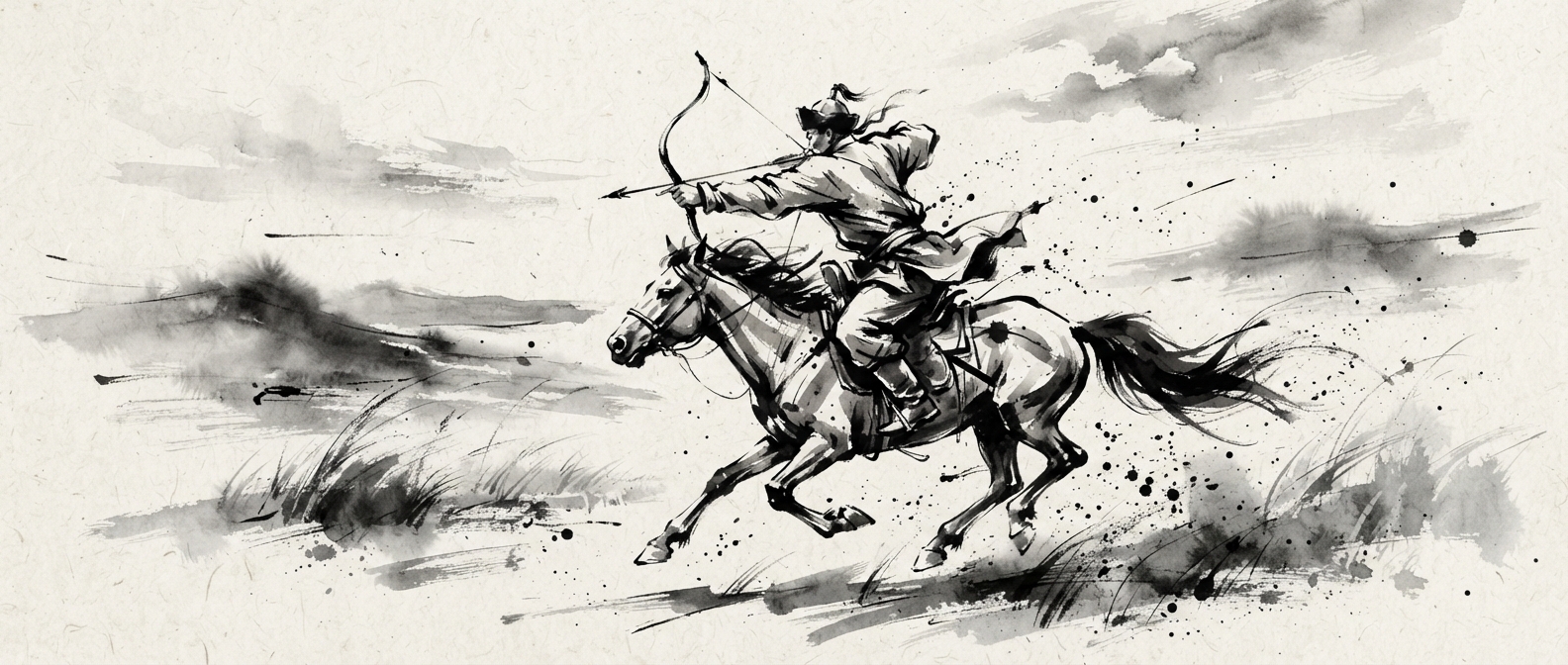
There is no single horseback archery format. Each organisation defines its own tracks, targets and time limits.
Original Kassai System (WFEA)
According to the WFEA rules, the track is a straight 99 m run that must be completed at a canter within 20 seconds, timed by photocell to a hundredth of a second. There are nine scored runs after warm-up runs at walk, trot and canter. The target is 90 cm across, 9 m from the track centre line, centred 2 m high and rotatable; rings score 4, 3 and 2 points, and time saved is added to the shooting score.
Korean events
According to Wikipedia, Korean events include the single shot (a side target on a 90 m track), the double shot (one target in the first and one in the last 30 m, angled backwards), the serial shot (five targets about 20 m apart on a 110 m track) and mogu, where archers shoot ink-marked arrows at a ball towed by another rider. All arrows must be carried by the archer or on the horse.
IHAA
According to IHAA, its European Grand Prix has run since 2014 with three-person teams. In 2014 it used Hungarian, Korean, Polish, modified Turkish and Mamluk tracks; in the 2020s it uses Tower, Raid and Hunt tracks, grouped as “Horseback Archery Eventing”.
World Nomad Games
The Astana Times describes four styles at the 2024 Games: Hungarian (three 90 cm targets side by side over a 100 m section), Turkish, Korean or Asian (three square targets 20 cm above the ground every 30 m) and the Kazakh zhamby (a 30 cm target hanging from a 2.5 m pole). Eurasianet describes the 2026 Kyrgyz style: three arrows at three targets 10, 15 and 10 m from a 90 m track within 16 seconds.