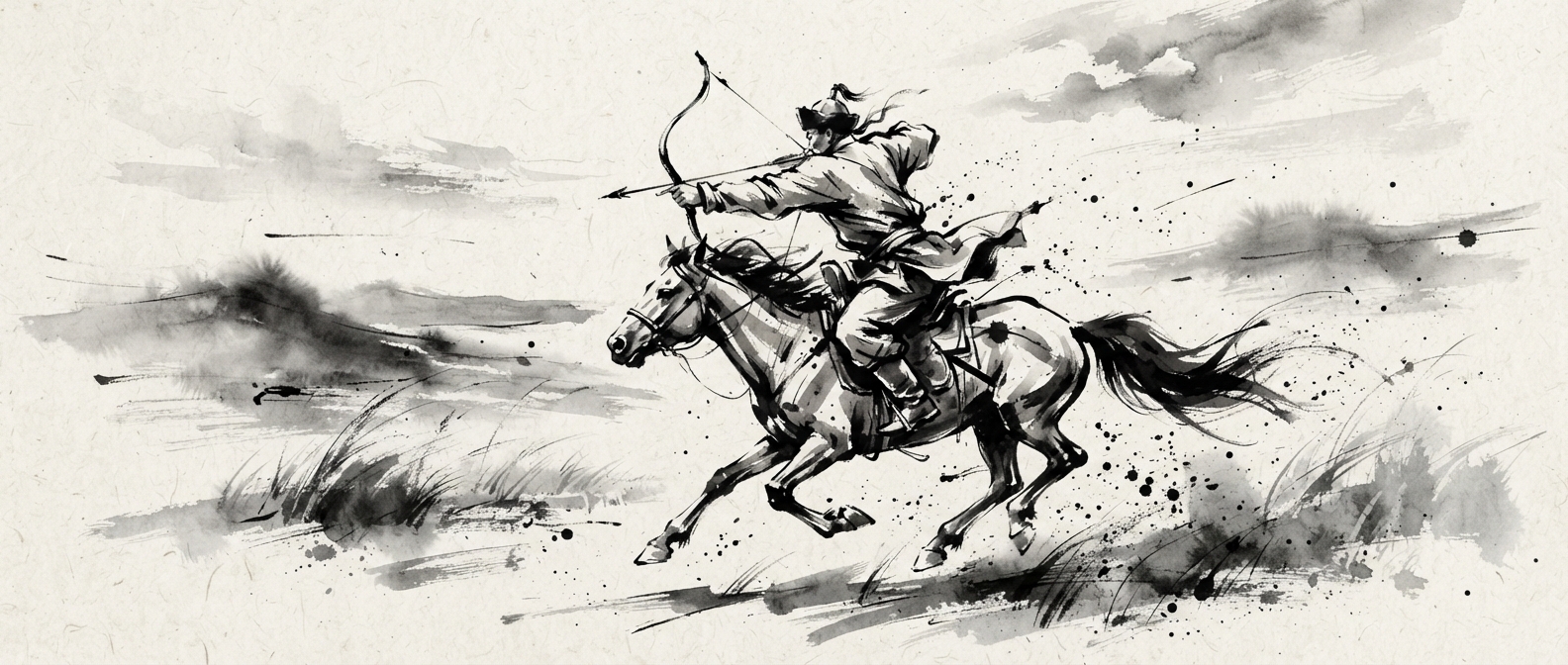
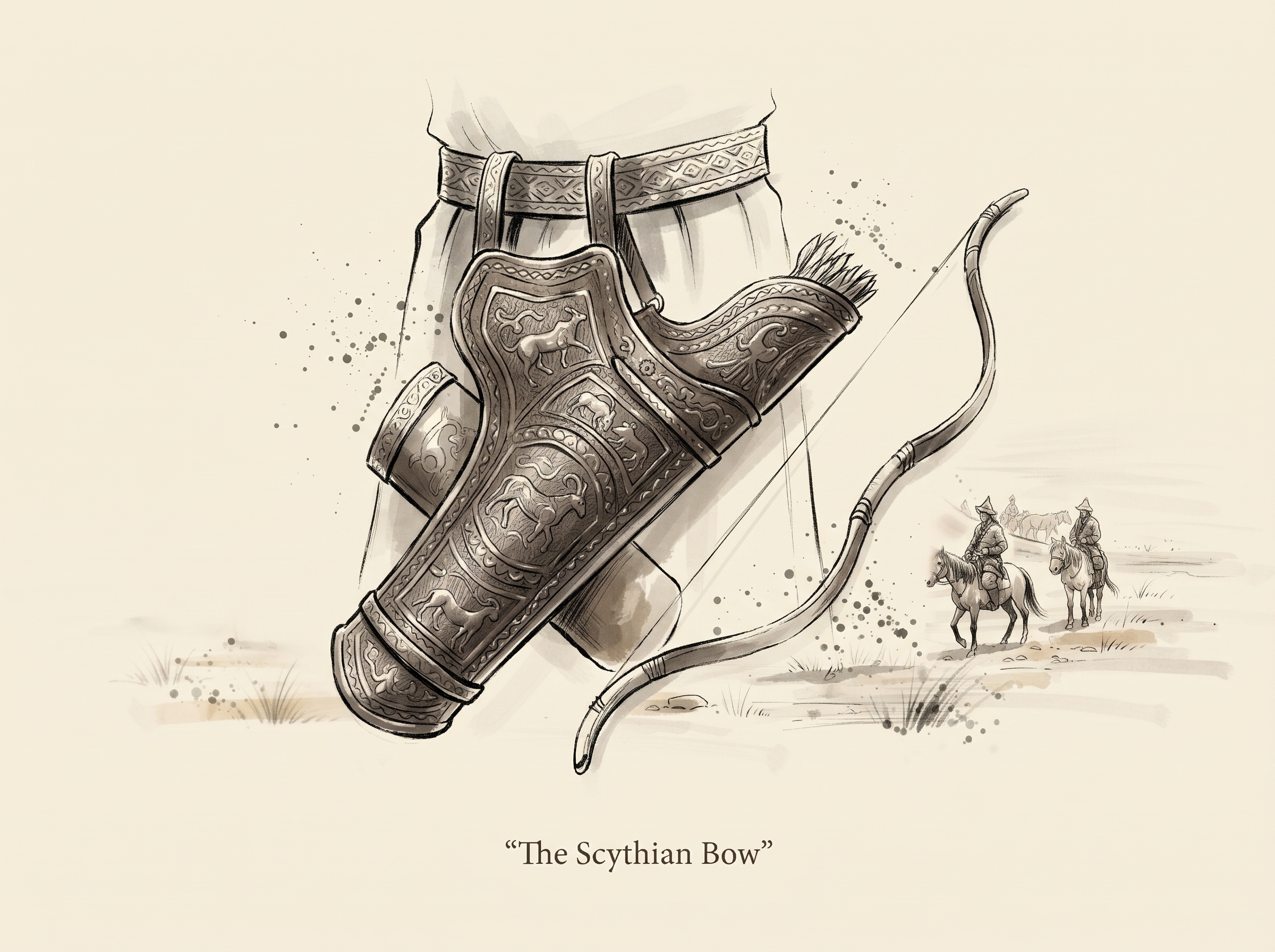
The Scythians gave the classical world its image of the horse archer: short, powerful, double-curved bows carried in an ornate case called the gorytos.
Royal graves
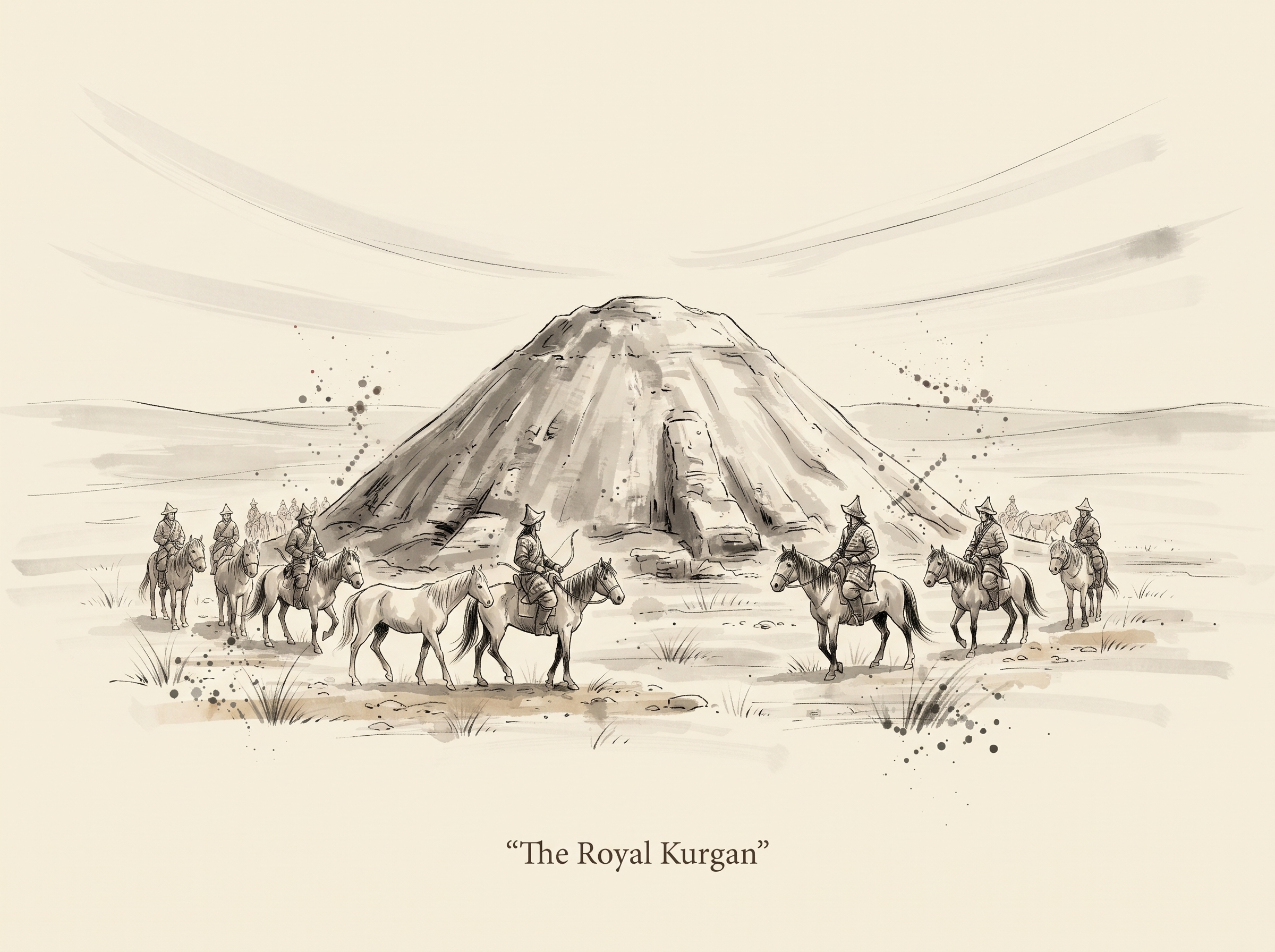
The royal burial of Arzhan 2 in Tuva (Russian–German excavation 2000–2003, led by K. Chugunov and H. Parzinger) dates to the late 7th century BC. The man was buried with a gold quiver, painted wooden arrows, three-bladed iron arrowheads decorated with gold and animal motifs, gold-mounted quiver straps and a bow beneath the quiver. The grave held about 9,000 objects, some 5,600 of them gold. From the 4th-century BC Chertomlyk kurgan on the lower Dnieper came a gold-covered gorytos showing scenes from the life of Achilles, and eleven horses with gold and silver harness.
The Scythian bow
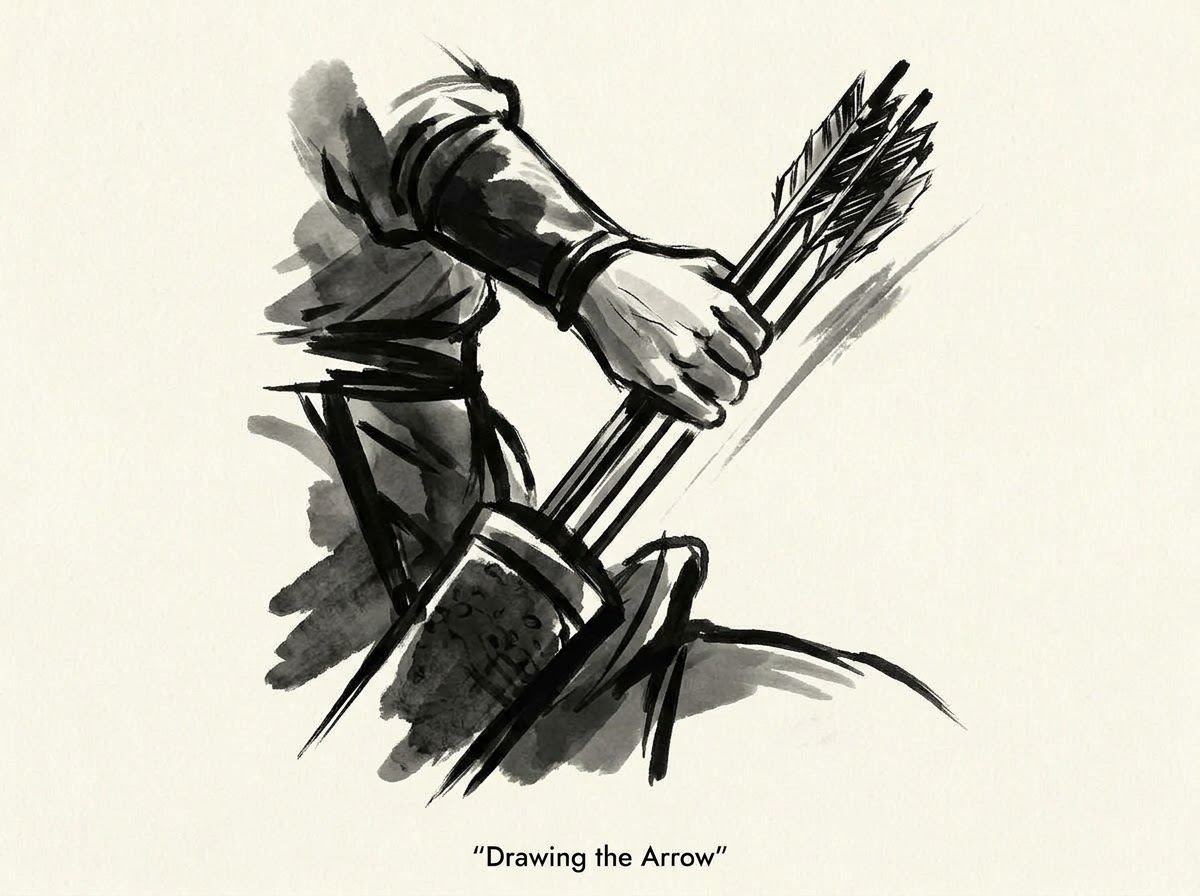
According to S. I. Lukyashko (2015), the sigma-shaped bow arrived in Eastern Europe with the Scythians no earlier than the late 7th century BC and by the end of the 6th century had displaced the older angular bows everywhere. His argument rests on arrowheads: heavy two-bladed points gave way to lighter three-bladed ones. He also suggests the idea of the sigma bow may have arisen independently in the North Caucasus and in China during the Bronze Age.
A Russian text attributed by its publisher to E. V. Chernenko states that only one well-preserved Scythian bow is known from the northern Black Sea region, from the Three Brothers kurgan near Kerch (1967), measuring 64.5 cm. Terenozhkin and Ilyinskaya gave 70 cm as the maximum length of Scythian bows, while the same author argues from arrow lengths that some reached about a metre. The shape was sigmoid with asymmetric limbs, as seen on the Kul-Oba vase.
